

By Kimine Mayuzumi
Did you build some undesirable habits during the work-from-home period last year? Do you want to change them? Or have you considered changing them? If yes to any of the questions, please keep reading.
Now that many people are physically back to campuses or workplaces and adjusting to their new (or old) ways of life, some of the habits may have faded away as the environment has changed. But you may still want to change or cut down other unwanted habits so that you can make more time and space for better practices.
Habits are the behaviors you repeat automatically following the cue that triggers you to unfold the behavior. Your body remembers the immediate rewards following the behavior whether they are desirable or not. It is the habit loop starting from Cue, then Routine (the habit behavior itself), and Reward (immediate comfort or pleasure you get) that lets the behavior come back over and over. (See Changing Habits)
Habits are not always bad. There are good habits too, which may include brushing teeth after every meal. For the habit, Cue may be finishing a meal; Routine is brushing teeth; and Reward could be the clean and refreshing feeling that the behavior brings. Other good habits may be journaling or meditation first thing in the morning, exercises before work, and a connecting time with your beloved over tea after kids going to bed.
Then bad habits may include: munching unhealthy snacks throughout the day; checking email right before bedtime; and going through Social Media whenever opening their smartphone.
One of my habits I wanted to change was watching YouTube videos in bed until I switched off the light. For this, Cue was going to bed with my phone; Routine was watching YouTube videos; and Reward was to be entertained.
Why was it a bad habit? What makes some habits undesirable or detrimental?
An unwanted or undesirable habit may:
- Damage your health in the long run
- Suck up energy and/or time undesirably
- Bring negative energy
- Deprive you of sleep (quantity and quality)
- Prevent other good practices from arising
My screen time in bed applied to every single item on the list above (see Why it’s time to ditch the phone before bed). It sucked up my precious reading time. Not good for my sleep quality or quantity. Blue light must have been harmful to my eyes and more.
Given all the negative effects of a habit you can think of, you may still follow the temptation as your body remembers the temporary comfort and attraction. Or you may think “oh, well, nobody is policing or telling me not to do it. Why bother?” At times, you may not even think about what you are doing and fall into the default whenever reaching the cue stage.
Yes. Habits are hard to change because they have become H.A.B.I.T.S – Hard to Alter Because It’s Too Stubborn.
It could be impossible to change unless you implement your intention and system to disrupt the habit loop. Next, I will introduce a system you could implement to change your habits.
6 tips to change your habits
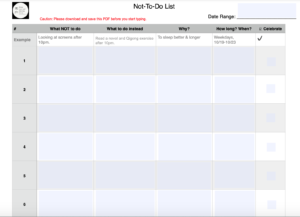
Based on the tips I am discussing below, I have actually created a resource sheet (system) to make it easier for you to change your habits. So I recommend you read the tips first and then take a look at the resource sheet, which you can download from here.
1. Replace it with something else
Trying to quit a habit is not good enough. – You need to replace the undesirable habit with another practice that is more desirable and easy. Simply suppressing your desire to follow the habit loop is not sustainable or effective. It may work only temporarily and even agitate you after a little while. Instead, if you have an alternative practice that helps you better in your life, you can shift your focus to it and even disrupt the old habit loop. The alternative would distract you from the old habit.
2. Remember why
It is important to remind yourself of the reason(s) why you should replace your old habit with a chosen practice in the first place. Write down what made the habit undesirable for you especially when you start implementing your great intention with a new practice. There are possibly many times when the gremlin tries to get your attention and takes you back to the old habit as soon as you come across the cue triggering your temptation. But the clear voice in your head with legitimate reasons why you wanted to replace the habit may be able to push the gremlin away.
3. Focus
Good intention works better (and longer) when you have a focused timeline for the intention. If you think you have to work on the habit replacement forever or without a clear timeline, the commitment may more likely to become weaker along the way and even disappear. When you are aware of its finish line, you are more likely to follow through.
Similarly, choose one habit to replace at a time. If you try to change all kinds of “bad” habits all in once, that is not realistic but hard to handle. Everything becomes nothing. Choose one habit to replace for a range of days.
4. Share your commitment with a trusted one
As mentioned earlier, it is easy to slip back to the old habit especially when you are not held accountable for the commitment. Find a trusted one who doesn’t judge you or your behaviors but supports you and what you do. Share the plan with the person including all the items (what to replace with what, why, and the timeline). Without a support system, it’s easy to fall back into old ways and take the comfortable path.
5. Celebrate
When you achieve to replace the undesirable habit with a more desirable one for a period of time, make sure you celebrate it!! How? 1) Check off the replaced habit on the resource sheet. (Yes. It feels good.) 2) Reflect on how the process was and what benefits you gained as a result. 3) Report to your trusted one whom you had shared your intention with. 4) Like a winner, keep pursuing the desirable practice that may have become your good habit by then.
Please note: if your plan of changing habits didn’t go well in any case, don’t put yourself down. Reflect on the process and why it didn’t work this time. And adjust it and try again.
6. Use the resource sheet
For all the things I said above, the shared resource sheet will help you follow the tips. Since you may need an accountability buddy or group for this commitment, you can easily share this resource sheet with them and hold each other accountable.
Before filling your intention in your resource sheet, please download and save it first.
Using the resource sheet following the 6 tips was effective for me. I started reading a book in bed once again. I know changing my habits is still work in progress. But, after all, I am H.A.BITS of changes – Happy to Accept BITS of changes.
I wish you all the best!
Photo by Danielle MacInnes on Unsplash