

By Kimine Mayuzumi
Following up with the popular blog post, Beyond Bilingualism: 4 Tips for Raising Trilingual Children, I have decided to dig through my old file to find the piece I wrote six years ago and share with the readers. In the piece, I tried to see things from the perspective of my 8-year-old son when I wrote it. But, of course, it is obvious that my adult views are very much implicated. I meant to submit it to a children’s book publisher. I did once. But it didn’t work out. Since then, it had just been sitting in my file. So I found and modified it. I hope you enjoy reading it!
I speak three languages
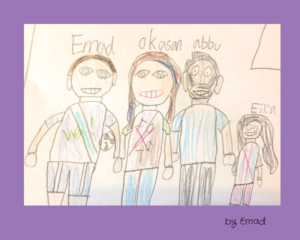 My name is Emad. I am eight years old and live in Michigan, USA. I have a little sister, Eilia, three years old. We both speak three languages. Yes, we actually do. All three are very different. One is Japanese, another is Bengali, and the other is obviously English. When I lived in Toronto, Canada, I heard different languages in public. But here in the midwest, English is usually the only one I hear outside my home.
I am a mixed-race child of Japanese and Bangladeshi parents. My mom speaks to me and my sister in Japanese. My dad speaks Bengali. The rest of the world speaks to me in English. Is it confusing to speak three languages? Yes, it can be. Sometimes wrong words slip out of my mouth. I say Japanese words to my dad and Bengali words to my mom. But, I am getting better – I can switch languages quickly these days.
There are some more challenges and even funny and convenient moments using three languages in my family. Let me share some of those here.
Brown skin
Nowadays my family and I laugh about an incident that happened when I was two years old. According to my parents, I started speaking Bengali to a Mexican young man at a Halloween party. My parents say that I was confused because his skin was brown like my dad. Well, now I know that not all brown people speak Bengali. There are so many languages in the world. But my “brown” language must have been Bengali at that time. But, it is actually not only me who gets confused. When I went to my friend’s house, there was a Mexican lady visiting them. She switched from English to Spanish when she started talking to me. I know I am brown too. I probably looked Mexican in her eyes.
Double work
My parents do not allow me and my sister to speak English very much at home although they speak English to each other. (Not fair!) Here comes a challenge for me. When we have a meal together at our round table, I speak Bengali to my dad and Japanese to my mom. But then, my dad doesn’t understand what I said to my mom, so I have to explain it to him in Bengali. It feels like double work for me.
Secret code
There is a handy side to speaking three languages though – I can communicate to my mom and dad secretly in public! For example, when I went to a grocery store a few weeks ago with my family and stood at the cashier, we saw a man after us with a cart full of Pepsi and Coke. It was a mountain of 2 gallon bottles. I had never seen a person buying that much Pepsi and Coke! That is when our secret code was useful. My mom spoke to me quietly in Japanese, “Look (at him). That is a lot (of Coke and Pepsi)!!” I giggled behind my mom. Likewise, I could tell my dad about the cart in Bengali without letting the man know what we were talking about.
It is also handy when we need to talk about things we don’t want to talk about in public or with others around. You know the terms like, peeing, pooping, farting, etc. Then we can switch words from English to Japanese or Bengali depending on where we are. When we visit Japan, we use Bengali as a secret code. When we visit Bangladesh, we use Japanese words just among our family members.
Embarrassment
When I play a soccer game for my team, my dad gets so heated that he often yells at me to give me directions in Bengali. I get embarrassed. But, come to think of it, he at least yells at me in the language nobody else understands. So other people don’t understand what he says or it doesn’t conflict with what my coach says. When my mom also gets excited, she starts calling me by my Japanese name. She sometimes shouts, “Fujirooooo Ike!” which means “Fujiro, go!” My parents say there is nothing to feel embarrassed about. But hearing both languages from my family during the game sometimes makes it hard for me to concentrate….
Media & technology
I think that it is not easy to keep up with language skills unless I hear and speak them everyday. So I watch a lot of Japanese TV shows like Doraemon, Captain Tsubasa, and Ultraman. They help me learn some Japanese words. Then my dad says that Japanese dominates our household. That may be true.
I sometimes speak Japanese to my grandma in Japan by Skype. I speak Bengali to my aunt in Bangladesh and to my grandparents in Kuwait. My parents say that it is thanks to technology that I can still talk to both sides of my family face to face. But I still prefer seeing them in person though.
“False friends”
In my family, we also play with languages. It is funny that a certain word in one language sounds like another word or sentence in another language. (That seems to be called ‘false friends.’) For example, Abunai(a-bu-na-i) in Japanese means “dangerous.” But, the same sound of Abunai in Bengali means “(There is) no dad.” (Abu or Abbu is “dad” in Bengali and nai means “no”). When I was saying to my sister who was holding a stick towards me, I said to her, “Abunai!” (Dangerous!) My dad showed up from the bathroom saying, “I am here.” My sister and I burst into laughter. My dad was smiling at us. Another example is “China,” which is a country in English, but in Bengali the same sounds mean “I don’t want (it).”
I love all three languages. It’s like I get to enjoy three different flavors of ice cream everyday. My favorite ones are vanilla, mango, and green tea. Yummy! I am so lucky. One day I might expand the range of flavors. But for now, I will stick to these three.
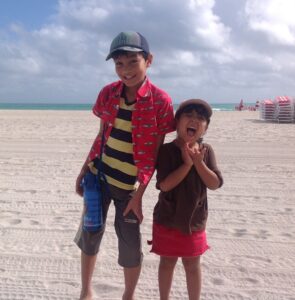
Penguin featured image by Ryutaro Tsukata
You might also like:
- Beyond Bilingualism: 4 Tips for Raising Trilingual Children
- Moving beyond White Supremacy and/or North America in Family Movies: 16 Recommendations