

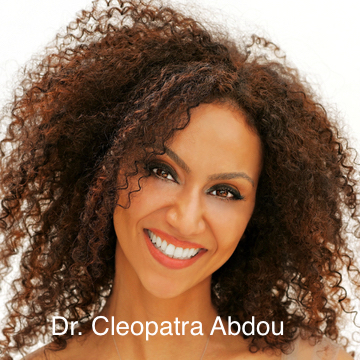
 In Part I, Dr. Cleopatra Abdou described how she practices harmonizing her life as a scholar, a professional, a partner, and a mother. Here, in Part II, she discusses her greatest challenge in harmonizing her life–adjusting to the cultural context of academia from graduate school through the role of faculty member.
Kimine: You said (in Part I), while being happy with your harmonized life, the academic culture has been one of the things that have challenged you the most. What do you mean by that?
Cleopatra: When I entered the world of academia, I really struggled to see how I could continue to be who I am and be successful at the same time. I seemed to have so little in common with the people who were thriving in the academy.
Transitions are when we are most prone to losing our footing in life, and this was certainly the case for me when it came to assimilating to the culture of academia without losing myself. By far, the most challenging points in my academic career were beginning my doctoral program and beginning on the tenure-track.
Kimine: What were the challenges of beginning your doctoral program?
Cleopatra: There were really practical ways that I struggled and floundered given the context that I brought to my understanding of academia. With the exception of our Dad who was sent to a seminary as a child to be educated, my siblings and I are the first formally educated generation in our family. I’m not just talking college-educated—I’m talking any education at all. When I started my PhD program, I had almost never used email, and I had very limited exposure to computers. I can still vividly remember sitting in lab in the middle of the night making my first poster presentation in PowerPoint, my heart racing and in tears. I was exhausted and frustrated, and I also felt ashamed because I was sure that I was the first person to walk those halls and have those problems. It wasn’t even the substantive content that I was struggling with. I was struggling to get the arrows and boxes to work the way I wanted. All of this sounds crazy today, but it’s true.
Beyond the practical ways I struggled, there were other things that I struggled with, but I couldn’t even quite put my finger on what they were. I interpreted my environment in a very literal and straightforward way. I didn’t understand the unspoken rules. I could tell that my peers knew something that I didn’t—something critical–but I had no idea what it was. I couldn’t articulate what it was, but I could feel it. I now know that they understood how to strategize to play in the big leagues in a way that I had no clue about. I had never been exposed to any strategy other than working my bum off, taking a leap of faith, and praying that I landed on my feet.
Kimine: How did you navigate through the challenge?
Cleopatra: I was quick on my feet; I was gifted at recognizing connections and patterns that many people would miss; I could learn complex concepts in a split-second with very little guidance; I had a persistence that most people wouldn’t bother attempt, whether for sheer boredom or exhaustion; I was agile in my perspective-taking and problem-solving abilities; and I could relate to almost any person you put in front of me–no matter their background or circumstances. This was a set of coping skills that was incredibly well-suited to the survival-oriented spaces I had occupied most of my life. But they weren’t very successful strategies for the higher-level goals I was attempting to achieve. I had to learn an entirely new set of coping skills to be successful in new ways–in ways that required being able to decipher the unspoken rules, pacing yourself in the pursuit of both short- and long-term goals and tasks simultaneously, and understanding when to start, when to stop, and when to consider something finished and ready.
Bottom line: In both very practical ways and ways that are much less tangible (but no less meaningful), I had a huge learning curve.
Kimine: How about the challenges you faced when beginning on the tenure-track?
Cleopatra: When I started my faculty position eight years later, the details were different (my deficiencies were at a much higher level), but my learning curve was just as steep. I, again, grappled with the question: How do I manage to be myself and succeed here? The stakes were higher than ever.
I was the first woman of color to ever be hired on the tenure-track in the particular school at USC. Being a new professor is hard for anyone, but there are so many additional layers of complexity that get dumped on top of that already challenging situation when you represent the first and only of some category of people; when, essentially, you made history.
I now understand that getting distracted and sidetracked by these additional layers of complexity is one of the most fundamental and insidious barriers to success for minorities, including women and women of color. If you want to succeed on the tenure clock, you need to take the most direct route from Point A to Point B. There isn’t much time for trial and error or learning on the job. You’ve got to avoid all of the detours and background noise within and around you.
People often say to me that it is nothing short of miraculous that I am where I am today, and when I see the facts laid out in front of me, I know they are right. I had no clue how I was going to navigate all those obstacles. But I was determined to figure it out. All of it. The arrows and boxes, the unspoken rules, how to be deliberate and strategic, and how to succeed in academia while being true to who I am.
Kimine: When you go through the hardships of being a woman of color in academia, what keeps you going?
Cleopatra: The thing is that this is hard, but it’s not nearly as hard as growing up without a mom like I did. So, no matter what happens, I maintain the perspective that: 1) I can survive and thrive in almost any circumstances, and 2) this is not really hard compared to what people are going through all over the world.
More importantly, I can be brave because I love my husband, my children, and my family so much. I have these beautiful people depending on me, my children. I want them to have everything I never had and so much more. I think of my mom and all of the sacrifices she made. I think of my dad and the unthinkable, horribly uncomfortable sacrifices he made. Rest his soul, my dad just passed away last year. For me, failure has never been an option. Now that I have children of my own, I don’t care how many times I fall down or how many times I have to pick myself back up. I will do it over and over again for them.
I will do it for all of the women and children in the world who need me to be able to use my voice to find and create more support for them in the healthcare system, in their workplaces, and in their relationships. When you know that you have something that you are put in this life to do, nothing can stop you. I am almost never too tired to work. I’m up with the baby all night, and, every night, I promise myself that as soon as my nanny gets here, I’m going to take a nap. But then she gets here, and I go straight into my office to work because I can’t wait to get back to work.
It also helps a ton that I have the most amazing husband in the world. He is the love of my life and my best friend. Everyday life is fun, loving, and sweet. I get to talk to him about every idea, every dream. I’m sure he never imagined himself being excited by the topics of fertility, pregnancy, and babies. But, since we met, he is, because he is so excited for me and for my work; he sees what a difference it makes in the world when women have someone to guide them through these most important parts of their lives. Having someone who believes in you, supports you, and takes up every bit of slack for you makes all the difference. I think I am unstoppable because of the way he loves me. And I am so incredibly thankful for that every single day.
Kimine: You are creating a path for so many minoritized scholars/professionals coming after you.
Cleopatra: I feel really grateful to be in the position to do these things. And maybe there are things about me that made this life possible for me, but I never forget that I have tremendous privileges and abilities to use my voice just because of where I was born. Had I been born in Egypt where my parents were born, I may not have discovered my voice to the same degree. I understand this privilege alone makes all the difference in the world. I cannot take credit for that. I can only do my very best with the privileged position I have been given.
Featured Image by johnhain through pixabay