
By David M. Hoffman
I love this blog and the dialog it inspires, but I’ve always found the mantra irritating: “Be Mindful, Trust the Process, Let Go of Outcomes.”
Don’t get me wrong. I’ve no doubts about power of mindfulness. And I’m more interested in process than many topics I’ve researched.
But … ‘let go of outcomes’ … Really?
Sometimes outcomes matter: job interviews, performance evaluations, tenure reviews. That said, outcomes are ‘a focal point,’ not ‘THE focal point.’ There are two less obvious, but far more important dimensions needed for highly interesting outcomes: focus and process. More interestingly, understanding their relationship means you can ‘let go of outcomes’ and paradoxically, ‘wind up with better outcomes’ when you need them the most!
My colleagues and I have collaborated on making sense of the focus-process-outcome dynamic. All three are key, like in ‘rock-paper-scissors.’ But this is where this blog’s mantra makes sense. Exceptional outcomes are the result of a type of focus and process many seek, but very few find. In this post, we explore the relationship between focus, process and outcomes using four visualizations. We hope you might see something familiar in our collaboration. And we hope our ideas bring a few new possibilities into view.
Visualizing the Relationship Between Focus and Process
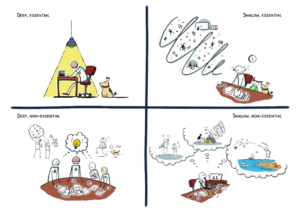
Two dimensions we’ve visualized are argued in McKeown’s (2014) Essentialism and Newport’s (2016) Deep Work. While both books are powerful, the tensions of these two ideas, as intersecting dimensions, reveals something almost mathematical about focus and process.
No Focus + No Process = No (Interesting) Outcomes
Essentialism is a disciplined approach to committing to an exceptional, game-changing focus, ignoring good, very good and even excellent alternatives. The essential is the “greatest potential contribution” of a person, team or organization. “Essentialism is not about how to get more things done; it’s about how to get the right things done.”
Deep work is about process. How the breakthroughs that define the cutting edge of knowledge are made, in an extended, long-term process inconceivable for many and rarely modeled.
Essentialism and Deep Work are powerful ideas on their own. But the tensions in these two dimensions, Focus (essential – non-essential) and Process (deep work – shallow work), hypothetically explain novel outcomes. We visualize this dynamic relationship using four visualizations and scenarios many might recognize.
Focus and Process that ‘Moves the Needle’ (Deep, Essential Work)
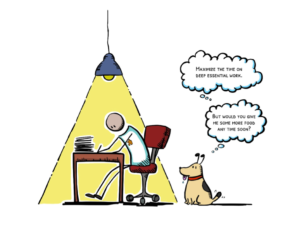
McKeown’s and Newport’s books feature several historical and current examples of people and ideas that changed the world. This happened when focus was locked on a game-changing idea, using a process that allowed enough time to think through and work out a breakthrough.
Most of us will never be as famous as the people, teams, companies and organizations who ‘moved the needle’ in a particular field. That said, deep, essential work is not about ‘being something.’ It’s about ‘doing something that matters.’ Something that’s never been done. We believe more of us could pursue highly interesting outcomes, if we focused in the way McKeown advocates, using the process Newport spotlights.
“The Whirlwind” (Shallow, Essential Work)
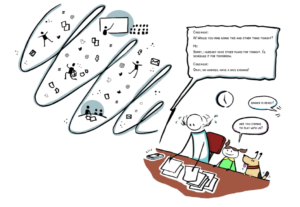
Even if we convince you to (re)focus on your scholarly dreams, using a process actually geared for that, we can’t eliminate “the Whirlwind” (McChesney et al. 2012). The whirlwind is: emails that actually need an answer; meetings necessary for organizational function; teaching and guidance our students need; service to your organization and discipline; article reviews; conferences; associations; partnerships beyond the campus. All of those things are essential in higher education. That said, these are often shallow commitments, except initial or exceptional efforts. All organizations have their own whirlwind.
Our whirlwind in academia is a generic skill-set, important, but routine. Interesting outcomes require keeping our whirlwind in perspective, allowing for the development of both a novel focus and a process geared to realizing it.
Collaboration (Deep, Non-Essential Work)
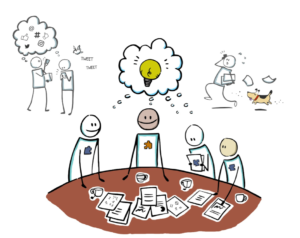
Deep, non-essential work means collaboration you count on, from teammates who can do something you can’t. The illustrated blog post my colleagues and I did, focused on the relationship between key ideas, is a concrete example of collaboration. While my text was an initial step in the right direction, their facilitated visualization was needed to bring a more profound understanding of these ideas fully into view.
Collaboration linking focus, process and novel outcomes is rare, compared to rudimentary ‘cooperation’ typical in our whirlwind. Many have not yet experienced rewarding collaboration with colleagues locked on an out-of-the-box focus, using a novel process that results – on a good day – in a unique outcome. That said, the reason we chose to do an illustrated blog post is to stress collaboration can happen! We believe unique outcomes are far more likely if the relationship and dynamic balance between our first three pictures (above) are better understood. And if our last picture: “drama, dressed up as scholarship,” is minimized to the extent this is possible.
Drama Dressed up as Scholarship (Shallow, Non-Essential Work)
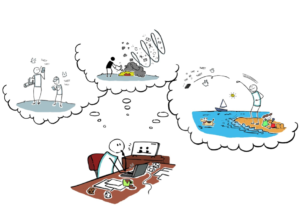
Newport (2016a; 2016b) argues that if much of the “activity” you are doing, at work, can be replicated by a teenager with a smartphone, you soon might be replaced by … well … a teenager with a smartphone.
More seriously, we collaborated on these ideas because many of us began our careers with ambitions of work that is significant, original and widely appreciated. However, by the time many are negotiating precarious transitions, high hopes have been replaced by a relentless shallow, non-essential, fragmented “activity” many accept as “academic reality.” Many believe this is “a price that must be paid” to become a scholar.
Our framework, on the other hand, while acknowledging the reality of shallow, non-essential activity, presents four scenarios. Three of our pictures are necessary to continuously and dynamically balance in order to pursue interesting outcomes. And one … well, one isn’t…
OK, Let Go of Outcomes
Our four visuals are an oversimplified view of a complex world. The key idea we stress: a dynamic balance between the first three scenarios is a good thing. Equally good: the idea the last picture is one to minimize, if interesting outcomes are your endgame.
Full disclosure: this is a work in progress. However, our collaboration made us want to challenge prevalent ideas about what deep essential work and collaboration looks like, at its best, and what it is not. It is never too late to challenge the assumptions we hear every day that govern our focus and a well-thought-out process.
Easy for me to say, right? I’m in a position of privilege, more secure than many who might benefit from reading this post. That said, these ideas have been validated by my closest collaborators. Most of us began developing our own focus and process when our careers were defined by precariousness. There are alternatives to answering work email at 11:30pm on a weekend night, missing children’s soccer games because of funding deadlines or serving on a committee that will accomplish nothing – at the expense of working on an idea that might actually make a difference.
What is easy to miss: outcomes are not in our pictures. NONE OF THEM. If you want outcomes that are ‘outside the box,’ understand what’s ‘inside the box’: Focus and Process.
We need less “drama dressed up as scholarship” and more “scholarly work that matters.” If you’d like to try more of the latter and avoid the former, my suggestion: start with focus, find and trust your process and let go of outcomes – but don’t forget them!
Front Bird Photo by Glen Carrie on Unsplash
Graphics and Visual Facilitation by Heidi Säntti, Anna Ruotanen & Tiina Hoskari
Acknowledgements
An early version of these ideas appeared in the ECHER blog. I’m grateful to ECHER’s editors, Melina Aarnikoivu and Jelena Brankovic, for initiating the challenging collaboration, along with many interesting and humbling conversations, as we’ve worked through these ideas and put them into practice, especially with Melina and the Migration, Mobilities and Internationalization research group!

I’ve also been fortunate to work with visual facilitators Tiina Hoskari, Anna Ruotanen and Heidi Säntti at Family Creatives. It was not until I teamed up with these out-of-the-box artists that I fully understood the fundamental issues in play, as they’re now presented here.

It’s my current work with Jawaria Khan, Quivine Ndomo, Maria Barbosa Lima-Toivanen, Driss Habti, Maria Pietilä and Taina Saarinen that’s brought the powerful dynamic of focus, process and outcomes fully into view.

Because I’ve been talking about several of these ideas since (at least) 2013 with Riyad Shajahan, as well as following this blog run by Kimine Mayuzumi, for the past several years, my hope is to now offer these ideas as a contribution to that ongoing conversation.

Finally, I’ve enjoyed hours of talking about these ideas and their potential with my son, Ville, as well as frequent spontaneous conversations with my son Veikko and my wife Tiina, all of whom have a focus and process different than my own. Without the rich connections between these colleagues, artists and my family I never would’ve glimpsed any of this. For that, I’m deeply grateful.