

By Kimine Mayuzumi
You may already know this in your body, even if it’s easy to forget:
It is vital to have a support system—a circle of friends and colleagues, both inside and outside the academy.
In a past blog post on imposter feelings in academia, we shared how important it is to build one’s own support system to navigate the shame that is so common in academic spaces. Alongside the competitive culture of academia, the increasingly unstable conditions of higher education can add layers of uncertainty and stress. Over time, these conditions can quietly invite self-doubt and isolation – unless we intentionally create places of support and steadiness for ourselves.
This year, what if you approached building your support system gently – by creating a simple list of your backers? These are the people or groups you might keep on your radar, simply as a way to stay aware of the support that exists and is available when needed. Making this list visible and easily accessible can soften the sense of carrying everything alone. It can be a small, grounding step toward more ease.
In this post, I’d like to share resource sheets I created – fillable backer lists designed to help you notice, build, and return to a support system that works for you, in a way that feels sustainable.
Building your own support system: creating a list of backers
Before doing anything, let’s pause with this question:
How might having a list of backers support you?
You may notice that it:
– helps you name what support you already have… and what you may be longing for;
– invites you to diversify your sources of support over time;
– makes it easier to reach out, rather than trying to push through on your own; and
– allows you to decide more calmly and clearly who to contact when something arises.
Often, the process of creating the list is just as meaningful as the list itself.
As I reflect on the people in my own life, I often feel a sense of connection simply by bringing them to mind. That feeling alone can be grounding and reassuring. At times, it even nudges me to reach out – to say hello, or to remind them that I, too, can be on their radar for support when needed.
At the same time, creating a backer list can help clarify unmet needs. When I notice a certain kind of support is missing, it becomes an invitation – not a failure – to slowly expand my network or seek out resources that might serve me in this season of life.
Resource sheets: creating your own backer list(s) in 3 steps
Below are three resource sheets you can use to create your backer list(s) and begin putting your support system in place – at your own pace.
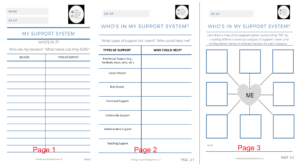
Step 1
On Page 1, you write down names as they come to mind. Begin with whoever comes to you today. In the next column, note what kind of support each person or group might offer.
Step 2
On Page 2 (or Page 3), reorganize the list by type of need. This allows you to think about your needs first and then identify relevant backers. This often mirrors the steps you take when a problem arises.
Step 3
On Page 4 (or Page 5), you draw a visual map of your backers surrounding you as “ME.” This page is less about precision and more about helping you feel supported and held, even visually.
A few notes about the resource sheets
– You don’t need to complete every step. After Step 1, you can choose either Step 2 or Step 3, depending on what feels most supportive.
– Page 2 and Page 3 each offer different versions:
* Page 2-2 allows you to type in your own support categories.
* Page 3-1, instead of Page 3-2, can be printed so you can draw your map by hand.
– Please download and save the resource sheets before filling them out, so you can keep your completed versions.
A few things to remember as you create your list
– Your backer list is always a work in progress. It will change as your life and needs change. There is no perfect version.
– Building a support system takes time. If your list feels short or empty, that’s okay. Awareness itself is a meaningful beginning.
– It helps to diversify your backers, so support doesn’t rest on one or two people alone.
– Reaching out for help is part of an ongoing cycle of giving, receiving, and generosity.
– If someone isn’t available when you reach out, try not to take it personally. Timing matters. You can adjust your list, approach another person, or return to the same person at a different moment.
I wish you steadiness, connection, and support – exactly as you need, exactly where you are.
Selected Resources on asking for help
Who’s in your support system? (Thrive Global) by Tamara Hartley
There Is No Guru (Inside Higher Ed) by Kerry Ann Rockquemore
Burning Out (Inside Higher Ed.) by Colleen Flaherty
Starting a Tenure-Track Career (Inside Higher Ed.) by Melissa Dennihy: